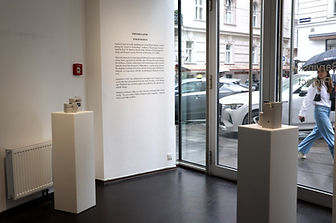
E X P O S E D L A Y E R S
The project is part of a residency program in Southern Serbia/ Svinjaricka Cuka “Artists in Archaeology.” This residency is a collaborative project initiated by Prof. Dr. Barbara Horejs, Deputy Managing Director of the Austrian Archaeological Institute, and Rosaura Cauchi, Director of Barvinskyi Art Gallery.

This body of work was born from time spent at an archaeological excavation site; not as a scientist, but as an artist moving alongside a team of researchers who were digging into the deep history of human migration in the Balkans. I was invited as an artist-in-residence, and what I found there was not only fragments of pottery and stone, but a deeper sense of connection; between the material remnants of the past and the way we carry memory in our bodies, our tools, and our gestures today My work here moves across three forms: cyanotype prints, sculpture and film.Each explores the relationship between absence and presence, between surface and depth, between what has disappeared and what we can still trace.


The cyanotype prints were made directly in the field. They are photograms blueprints of fragments excavated from the ground. In many of the works I present only the negative print, the empty silhouette of the object. These absences are not voids, but evidence of where something once was. They speak to how memory works, layered, partial, slowly fading and yet never fully gone. Just as stratigraphy guides the archaeologist by what layers remain, these images invite the viewer to read into what is missing.
In all these works, I am not aiming to reconstruct history. Instead, I’m interested in how fragments of the past resonate in the present, how material can carry meaning across centuries, and how something as simple as a missing piece can speak louder than what is whole.

The film brings all of this together. It weaves the sound of tools, the gestures of excavation, and fragments of spoken memory, especially the voices of the archaeologists, whose daily engagement with the soil reveals an almost poetic relationship with time. The narration, which you hear in the film, is written from my point of view, a response to what I saw, heard, and felt on site.
It speaks of layers, of burned remains that speak louder than intact ones, of hands brushing dirt from broken vessels, and of those early pioneers who once passed through this region carrying tools, seeds, and stories. Their traces are faint, but they remain.